It is no longer a question of whether tech skills are relevant for library and information professionals. They are the new professional literacy." Prof. Adefunke Ebijuwa
April 29, 2026 | 4 mins
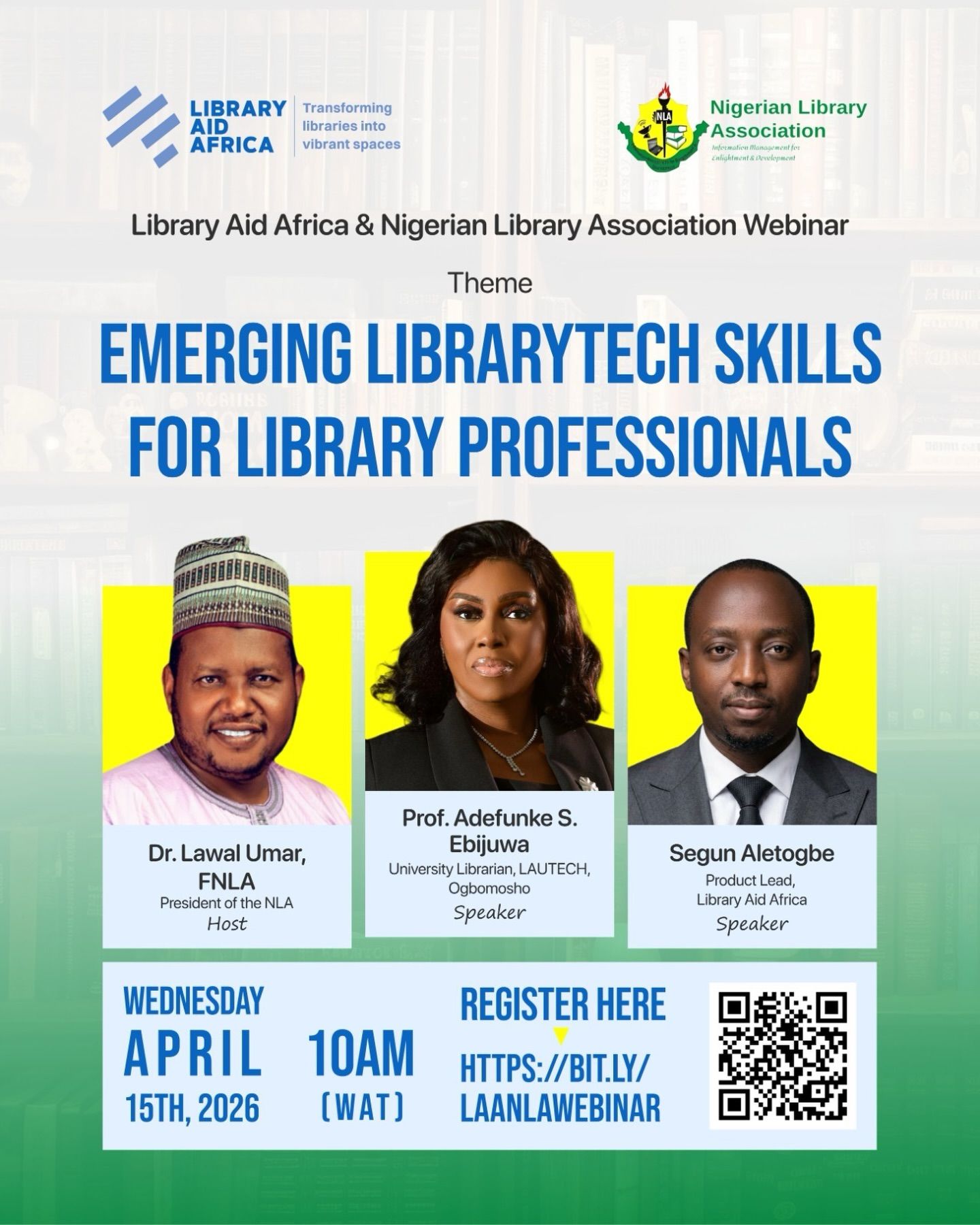
The library profession in Nigeria is at a turning point. The question is no longer whether technology matters for library and information professionals; it is whether professionals are moving fast enough to keep up. This was the conversation that brought over 100 library professionals in Nigeria together on Wednesday, April 15, 2026, when Library Aid Africa and the Nigerian Library Association (NLA) hosted a webinar titled "Emerging Library Tech Skills for Library Professionals."
The webinar featured Dr. Lawal Umar, President of the NLA; Professor Adefunke Ebijuwa, University Librarian at LAUTECH; Segun Aletogbe, Project Lead at Library Aid Africa; and Damilare Oyedele, CEO of Library Aid Africa.
Dr. Lawal Umar opened the session by speaking about the NLA's commitment to supporting Nigerian library professionals to grow with technology. He spoke about the shared effort to support libraries and improve access to information and literacy across Nigeria, setting the tone for the conversations that followed. The webinar was the first part of NLA’s 2026 webinar series. An effort at capacity building for library and information professionals in Nigeria.
Professor Adefunke Ebijuwa in her speech mentioned that technology skills are no longer something only a few specialists need. Every library professional who wants to stay relevant must have them. "It is no longer a question of whether tech skills are relevant for library and information professionals; they are the new professional literacy."
She acknowledged that Nigerian library schools have laid a good foundation, but gaps exist with advanced library tech skills. Many professionals have little to no experience with artificial intelligence and are comfortable with basic digital literacy tools. Some institutions are still resistant to change, and a number of library school curricula have simply not caught up with what the profession now demands.
She listed the skills that have now become critical for every librarian. These include digital literacy, database searching and information retrieval, metadata creation and management, digital repository management, research data management, cybersecurity awareness, open access systems, artificial intelligence literacy, virtual reference services, remote library services, and digital preservation.
She also spoke about identity. How library professionals need to change the way they see themselves. A librarian today should not just see themselves as someone who manages books and information. They should see themselves as a digital knowledge strategist, a technology-savvy educator, and a research partner, someone with the power to make a real difference in their community and contribute to national development. To become this, library and information professionals must keep learning. Students must take charge of their own personal growth. Institutions must invest meaningfully in the future of the profession. In the midst of the obvious challenge of poor infrastructure and limited funding that libraries have faced over the years, we have opportunities we can leverage in librarianship. Nigeria, like other African nations, has a young, energetic workforce that is capable of not just adapting to global change but driving it. Young librarians have the opportunity to acquire library tech skills and lead library innovation in Africa. Part of that means making sure that knowledge from Nigeria and Africa is more visible and accessible to the rest of the world.
Segun Aletogbe brought the conversation down to library processes and activities that need urgent upgrades and tech applications. He showed participants how technology can be put to work in libraries right now. How data from everyday library activity can lead to better services, how AI can make certain tasks easier and faster, how software tools can be used to build new library products, and how digital marketing can help libraries reach more people. He worked participants through the application of library tech skills like library software engineering, library data analysis, libraries and AI, library digital marketing, library digital literacy and information technology, and library product design.
He also spoke about LibraryXAfrica’s role in helping library professionals build these skills. LibraryXAfrica is an edtech training program that provides library professionals with specialized library tech skills. Librarians are empowered with these library tech skills, and they are able to create library solutions and grow their careers as part of Library Aid Africa’s effort to move libraries forward in Nigeria and across Africa. By the time he finished, the path from where libraries are today to where they could be felt a lot more walkable.
From the conversation, it is clear that the knowledge and opportunities exist for library and information professionals. What is needed now is the will to go after the library tech skills the profession demands. As Professor Adefunke puts it, are we prepared enough to lead this change?
To learn more about join LibraryXAfrica, go to https://lxa.libraryaidafrica.org/
Written by: Peace Agada, Community Engagement Officer