Library Internet Governance Ambassadors Program: Promoting Digital Inclusion, Digital Literacy and Online Safety
January 8, 2026 | 4 mins
Author: Peace Agada
Library Internet Governance Ambassadors Program: Promoting Digital Inclusion, Digital Literacy and Online Safety
In this internet age, where people have access to information and data at their fingertips, new questions continue to rise around safety, privacy, and the ethical use of the internet. Within the library and information space, these concerns are even more pronounced. Internet governance bodies across Africa are working hard to create regulations and frameworks that ensure people are safe online, information is protected, and digital spaces are used responsibly.
The challenge has become how do we get people, especially young people and library users, to understand these rules and regulations and access safe information online. How do we help them hear, understand, and implement the work being done by the Internet Governance Forum in various African countries and states? Librarians have the potential to address the digital divide and build digital competences of the communities they serve. If librarians are trained to acquire these competencies, they can be channels to a safe and strong community who not just have access, but know how to responsibly use the internet. (Adeyeye 2024). An article published by International Federation of Library Associations and Institutions in 2017 described the need for librarians in Botswana to be involved in Internet Governance and understand issues that promote and hinder access to information and become agents of change. (Lebele and Ayanda Agnes 2017)
Through the Library Internet Governance Ambassadors Program, Library Aid Africa is building the capacity of librarians to understand internet governance and advocate and promote safe use of the internet and libraries. The program serves as a connection between internet governance efforts and everyday internet users, especially those who access information through libraries. The goal is to help library users and young people understand safe digital practices, the principles of internet governance, and the importance of using information ethically and responsibly.
Through this program, librarians across Africa are empowered to foster digital inclusion efforts, identify and respond to issues of digital literacy within their communities. Each ambassador is trained and tasked to address unique challenges in their community individually through a capstone project.
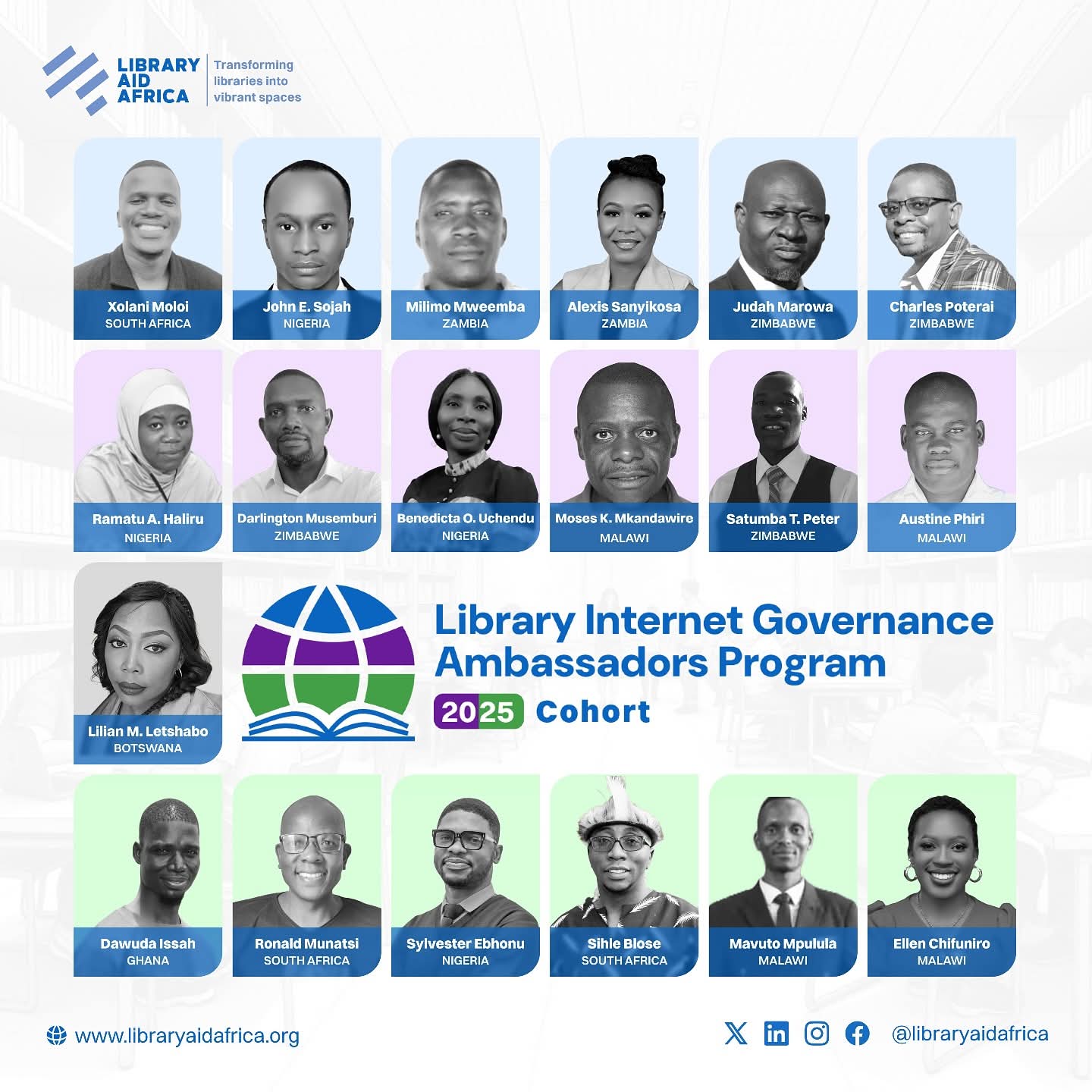
This pilot cohort includes 19 ambassadors from Botswana, Ghana, Malawi, Nigeria, South Africa, Zimbabwe, and Zambia with each ambassador working on internet governance projects within their local context.
From Malawi, Moses Makindawire has identified a pressing need to raise awareness about laws, policies, and ethical internet use among librarians. His project focuses on training librarians so they can, in turn, share knowledge with their users. He hopes to help them recognize misinformation, protect personal data, and use the internet responsibly. Moses will also work to build partnerships between libraries and local communities to ensure people understand the policies and tools available to keep them safe online.
Also from Malawi, Ellen Chifuniro is carrying out a research project to understand how well librarians in her country know about internet governance and the digital policies that guide it. Her research will lead to clear recommendations and strategies for strengthening librarians’ awareness of Malawi’s national digital policies and frameworks. Ellen is interested in helping libraries stay connected to national efforts around digital rights and safety in Malawi.
In Nigeria, Ramatu Haliru, a Librarian at the Arewa House at the Center for Historical Research and Documentation at Ahmadu Bello University Zaria, is taking another approach using webinars to educate both young library professionals and the wider public. Ramatu will be working with Internet Governance stakeholders in Nigeria to increase awareness about internet governance and information safety for the library community in Nigeria.
Another Nigerian ambassador, John Ezra Sojah is interested in tackling the issue of digital inclusion. His project focuses on bridging the digital divide by creating an open-access toolkit that supports library-based internet governance advocacy. John’s work will also focus on extending internet bandwidth to longer hours and weekends in his library.
Through the Library Internet Governance Ambassadors Program, we are seeing how librarians can serve as gateways and advocates to digital inclusion , digital literacy and internet safety.
References:
Lebele and Ayanda Agnes (2017) IFLA
https://repository.ifla.org/items/8b504295-8044-48a3-b0f2-f22a5dc669e4?utm_source=chatgpt.com
Adeyeye, Sophia V. "Bridging the Digital Divide: Librarians' Role in Empowering Nigerian Communities through Digital Competencies and Advocacy." Library Trends, vol. 72 no. 4, 2024, p. 712-726. Project MUSE, https://dx.doi.org/10.1353/lib.2024.a949579.
https://muse.jhu.edu/pub/1/article/949579?utm_source=chatgpt.com