Zambia National Library Policy: Insights from the Development Process
December 12, 2025 | 4 mins
Author: Peace Agada
As part of the ongoing conversations on strengthening library policy development in Africa, stakeholders gathered for another edition of the Library Policy Forum, a component of the Library Policy Fellowship organized by Library Aid Africa. The virtual event was held on 19th November 2025, bringing together librarians, government representatives, and library development experts from across the continent.
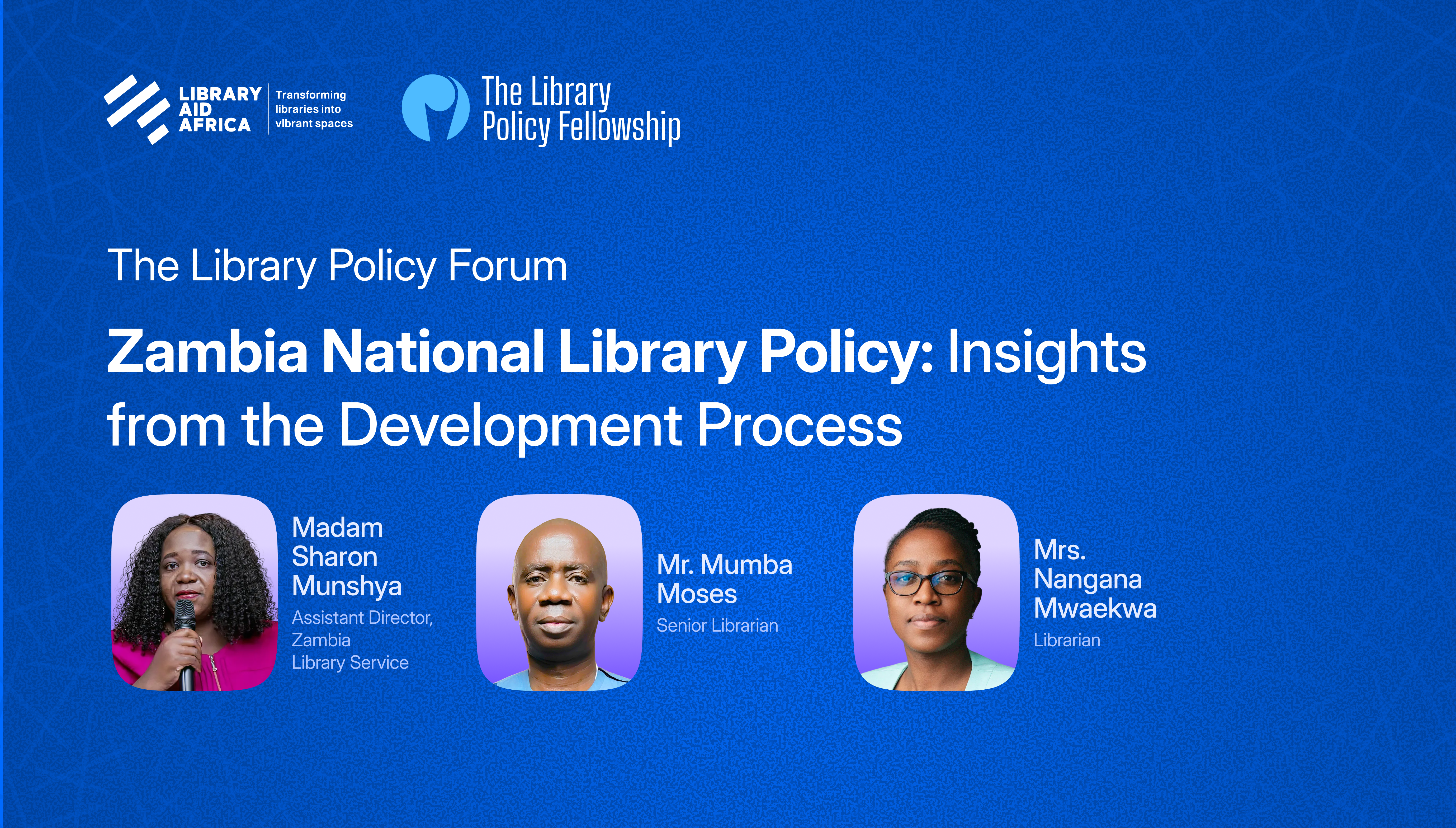
Zambia recently approved its first-ever National Library Policy, a process that originally began in 1967 but stalled for decades. Librarians restarted the effort in 2021, and through careful planning and collaboration with different agencies, research institutes, non-profits, and other stakeholders, they finalized the policy in 2025. During the Library Policy Forum, three key library stakeholders from the Zambia Ministry of General Education and the Zambia Library Service; Madam Sharon Munshya, Mrs. Nangana Mmwaekwa, and Mr. Moses Mumba shared the steps, challenges, and lessons they encountered on this journey. Before 2025, libraries and librarians had been operating without a structured framework which created gaps in standards, operations, and accountability. Restarting the policy process in 2021 allowed the country to address these gaps systematically and intentionally.
They explained that developing the policy was a long and deliberate process that required detailed planning and coordination. The team began by identifying gaps across the Zambian library sector including education, resources, and operational challenges through several consultative sessions. Determining who to involve became an early challenge and to address this, they carried out partner and stakeholder mapping to identify relevant ministries, government agencies, research institutions, and other key partners. A technical committee with representatives from multiple institutions led the drafting, review, and refinement of the policy. This process involved a series of meetings, consultative sessions, validation workshops, and conferences to ensure inclusiveness, transparency, and alignment across stakeholders. The panelists explained that working with different government wings, managing time, and making sure everyone was represented made the process challenging over the four years. Even with these hurdles, the team continued to collaborate, and review their work, which helped them align priorities, include all feedback, and finally move the policy to the cabinet for approval.
With the National Library Policy now approved, stakeholders expressed optimism about the next steps outlined in the document. These include the introduction of the Library Bill and the establishment of a National Library. They also expect stronger institutions, enhanced school libraries, improved capacity building for library and information professionals, and better access to information and education across Zambia. With the policy in place, librarians can now push for better accountability in library services and hold government agencies and institutions directly responsible for the development of libraries.
In sharing recommendations for other countries, Moses Mumba emphasized the importance of partnerships and collaboration.He encouraged countries to establish partnerships and leverage external support. He also urged them to embed ICT learning programs, prioritize digital transformation, and maintain transparency through consultative and validation sessions. He advised policymakers to plan ambitiously while remaining realistic. Nangana Mmwaekwa added that developing a national library policy is achievable when policymakers understand the national context. Identify gaps and areas for improvement early to bring relevant stakeholders into the process and ensure a truly inclusive policy. She noted that when the National Library Policy aligns with national development strategies and legal frameworks, the process becomes smoother. Madam Sharon Munshya reinforced the need for inclusiveness, transparency, and sustainability as a priority during the process. She explained that a national library policy succeeds when it grows from collective ownership and addresses the real needs of communities. These principles strengthen both the legitimacy and the impact of the policy.
Zambia has documented its journey and stands ready to support other countries interested in developing their own national library policies. The approval of the National Library Policy by parliament demonstrates that structured planning, broad stakeholder engagement, and alignment with national priorities remain essential for effective library development. These efforts ultimately advance education, literacy, and digital transformation through libraries, and the experiences shared by the panelists offer a practical roadmap for countries working to strengthen their library systems and expand access to information across their communities.